📅 Visited: January 2023
A bright red pond, steaming.
The place is called Chinoike Jigoku — “Blood Pond Hell,” which is not a name that undersells itself.
A few steps away, gray sludge was swelling and popping, over and over, with a thick blop, blop sound.
And a few minutes’ drive from there, a turquoise pool so saturated it looked like you could fall into it was throwing off huge white clouds of steam.
Red, gray, blue.
All of it coming out of the same town, out of the same ground. So why are the colors so different?

That simple question stayed parked in the back of my head for the rest of the trip.
First, what kind of town is Beppu?
Beppu sits on a slope that tilts gently down toward the sea.
And from all over that slope, white steam rises.
Not one plume, or two.
It comes up everywhere, continuously, as if the ground itself were breathing.
Why does this much hot water collect here, of all places?
The answer is said to lie in the cracks underneath the town.
A fault is a place where the ground has slipped and split. Those splits are believed to act as pathways connecting the deep underground to the surface.
Behind the town stand volcanoes — Mt. Tsurumi and Mt. Garan. Hot rock is thought to sit below them, and rainwater that soaks into the ground gets heated there.
Heated water becomes lighter and rises. It follows the faults upward and bursts out at the surface — and that, it is said, is what all that steam actually is.
A heat source, water, and a pathway. Beppu is said to have this much hot water because all three happen to line up here.
Once you know that, the countless plumes of steam start to look like markers showing where the cracks run.
The town itself may be a map of the shape of the ground beneath it.
| Address | Beppu City, Oita Prefecture |
| Character | A slope facing Beppu Bay, with steam rising all over town |
| Surroundings | Mt. Tsurumi and Mt. Garan behind; the Hells cluster in the Kannawa and Kamegawa areas |
Chinoike Jigoku — the red isn’t the water, it’s the ground
I started the tour of the Hells with the one that has the strongest name.
Blood Pond Hell.
Beyond the railing was a pond the color of rusted iron more than anything you’d call red.
Steam poured off it without pause, and the red surface shimmered behind the white.
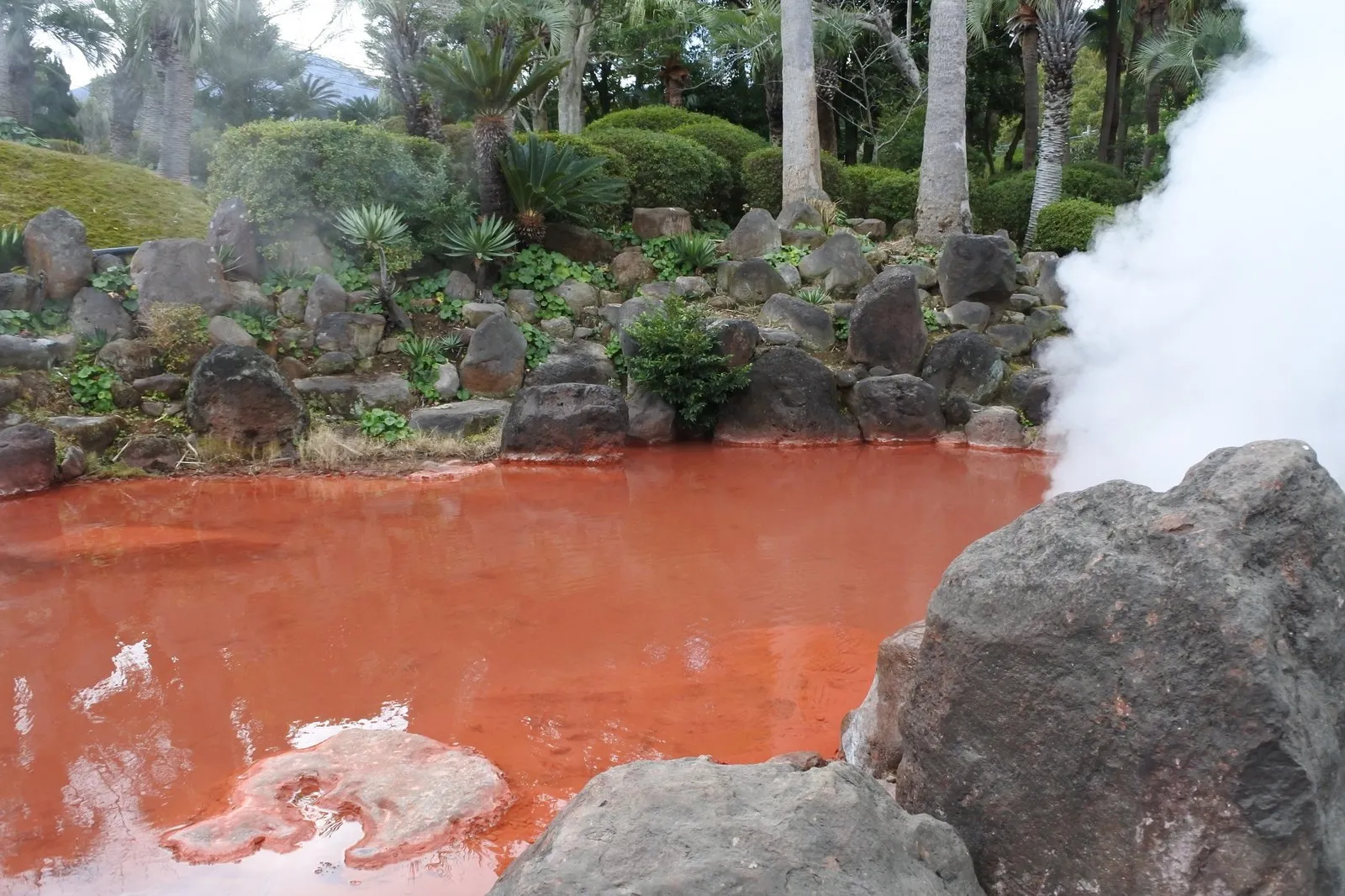
Then I got closer, and got a surprise.
The water itself is fairly clear.
What’s red is not the water but the ground sitting underneath it.
In the shallows the red bottom shows straight through, which makes the whole pond read as red from a distance.
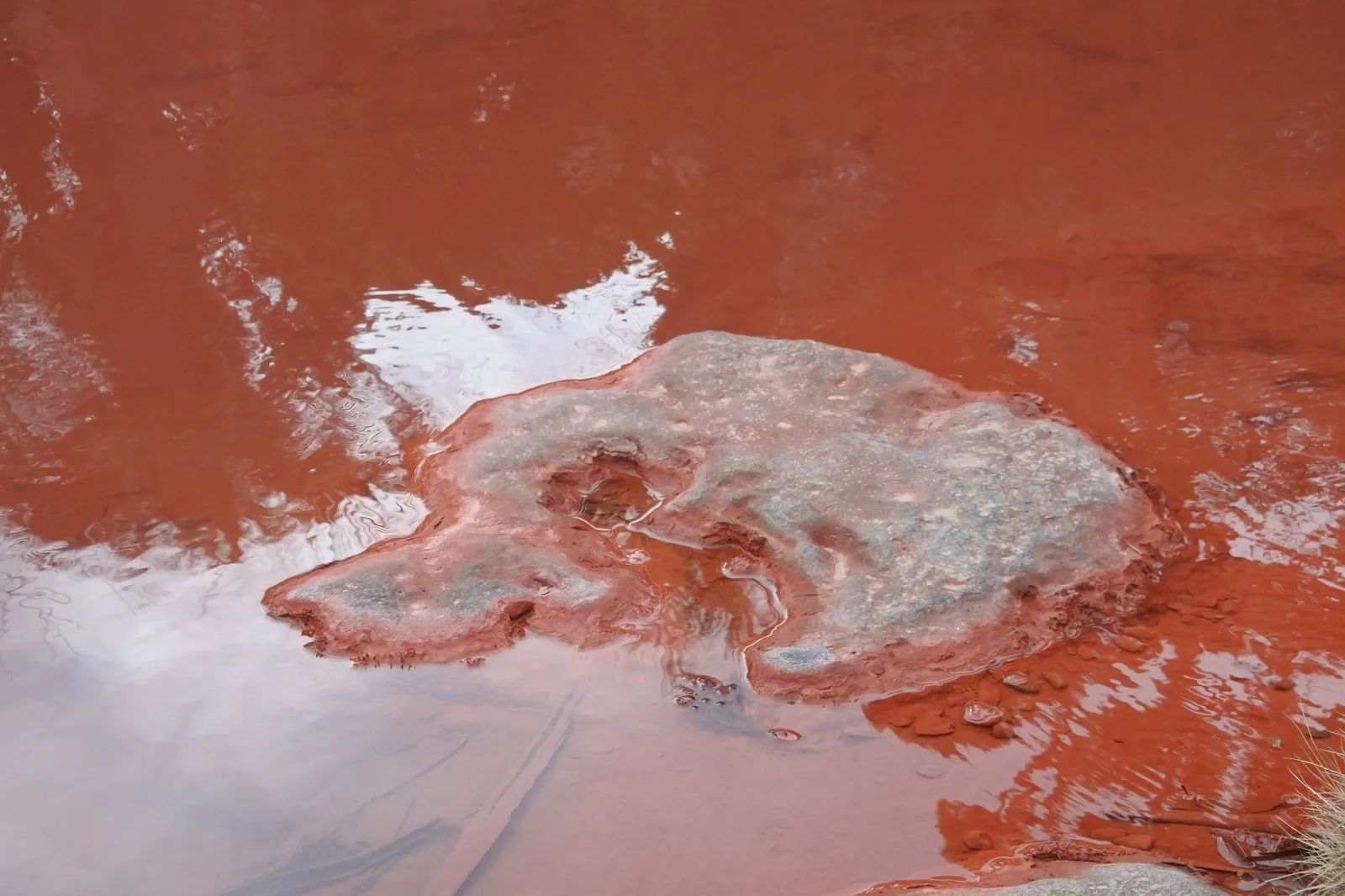
Toward the back there are deeper spots, and the color there looks noticeably different.
Hot water rising from deep underground picks up iron and other components from the rock it passes through. When it reaches the surface and meets the air, the iron is thought to oxidize into a red compound that settles to the bottom.
It is said to be much the same process as iron rusting.
So the red you're looking at isn't "red water" — it's a red sediment that the water has been laying down over a very long time. That's why the pond looks red even though you can see straight through it.
For a place with such a lurid name, it was quiet, and had a strange, almost artificial beauty to it.
| Address | Noda, Beppu City, Oita (Kamegawa area) |
| Parking | On-site parking available |
| Highlight | The rust-red pond — up close, the water itself is see-through |
| Note | Tatsumaki Jigoku is right next door; easy to visit both together |
Tatsumaki Jigoku — wait, wait, and then it blows
Right beside Blood Pond Hell is Tatsumaki Jigoku.
This one is a geyser.
You can’t just turn up and see it — it erupts once every 30 to 40 minutes.
I sat down on the stepped seating, which is arranged like a small amphitheater, and waited.
Then the moment arrives.
White water shot up hard from behind the stonework.
The eruption keeps going for six to ten minutes.
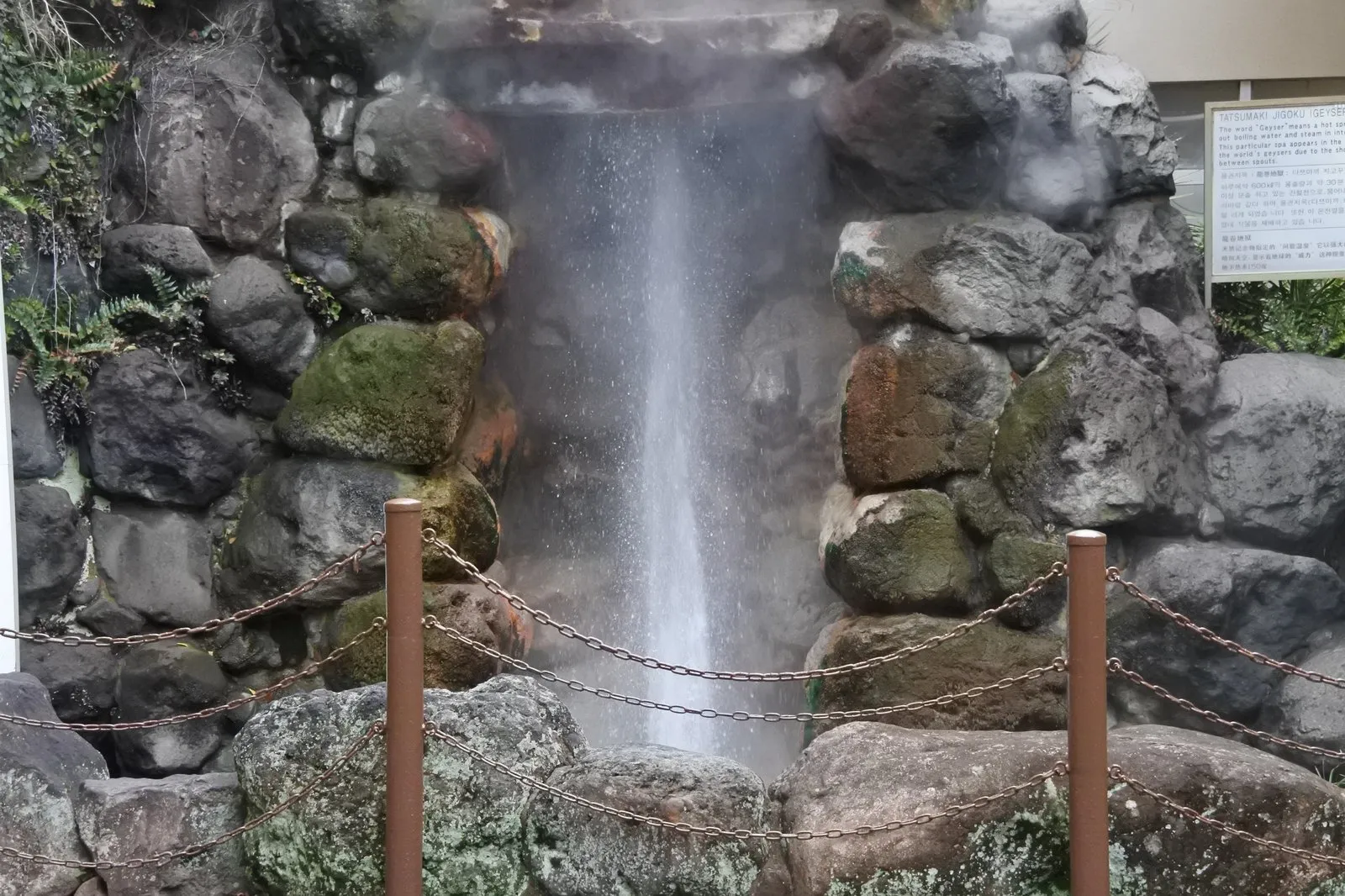
Honestly? It was smaller than I’d pictured.
I’d been expecting a column reaching for the sky, so there was a bit of an “ah, so this is it” moment.
Even so, the plain fact that the ground spits out water on its own schedule is quietly fascinating.
Once it has finished erupting the pressure drops, and it takes time for the hot water to build up again. So it is said to alternate between resting and erupting.
The interval stays roughly constant because the shape of the underground channel, the volume of water that collects, and the rate at which heat enters the system are all thought to stay much the same.
You could say the interval between eruptions is telling you the size of an invisible container underground.
| Address | Noda, Beppu City, Oita (right next to Chinoike Jigoku) |
| Parking | On-site parking available |
| Highlight | A geyser that erupts every 30–40 minutes for six to ten minutes |
| Watch out for | There's a wait before it erupts — leave yourself some time |
Umi Jigoku — a blue pond, and an overwhelming amount of steam
Next I moved over to the Kannawa area.
This is where I ran into the most impressive sight of the day.
Umi Jigoku, the Sea Hell.
The instant I stepped through the gate, my whole field of view went white.
The sheer volume of steam here is something else.
Somewhere behind all that white was a large pond shading from pale blue into soft turquoise.
The grounds are big, and every time I tried to take a photo the steam would drift across and hide the pond, then reveal it again.
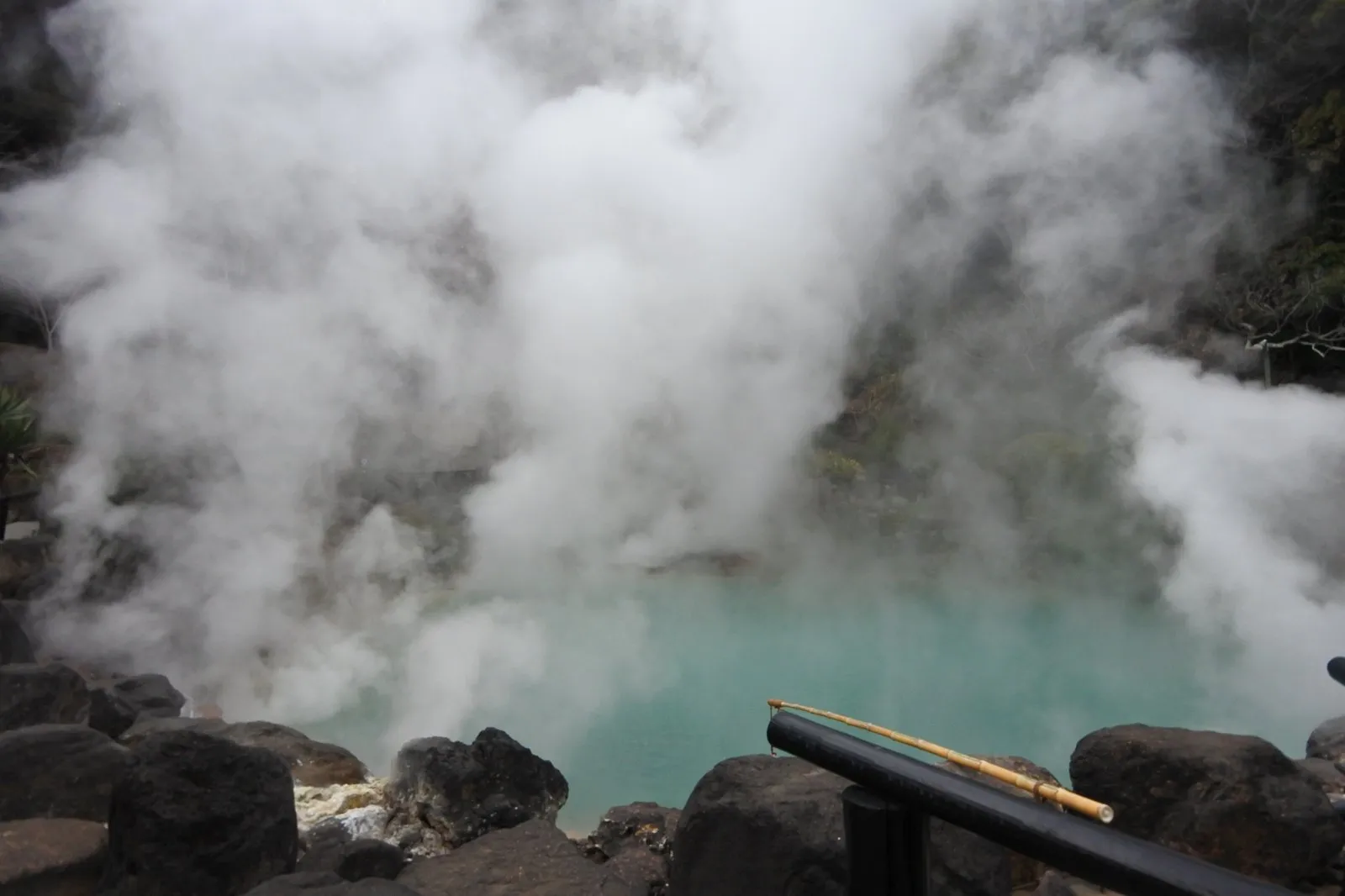
What I found interesting was running into “red” again — inside the same grounds.
Up near the foot bath at the top of the site, the water is intensely red.
To be honest, it looked redder to me than Blood Pond Hell did.
One part is the dissolved content — iron sulfate and similar compounds are said to be a factor in the blue appearance.
The other part is how light scatters. Water absorbs red light readily and tends to leave blue light behind. Add fine particles suspended in the water, and blue light is scattered back toward your eye, which is said to produce that milky pale-blue look.
The reason there's also red water on the same site is thought to be that each vent differs in the rock it passes through, what it dissolves, and its temperature.
A slightly different underground pathway changes the color completely by the time it reaches the surface — that, it is said, is why each of Beppu's Hells has its own face.
There’s one more thing about Umi Jigoku I won’t forget.
The onsen-boiled eggs.
They’re a hundred yen, handed over still warm.
Crack the shell and you get a soft waft of sulfur.
The yolk is cooked exactly right — moist, not set too hard.
The heat of the ground turned directly into food. An obvious thing, but it got me all the same.
| Address | Kannawa, Beppu City, Oita |
| Parking | On-site parking available |
| Highlight | Large grounds and enormous amounts of steam; a pale blue to turquoise pond |
| Local specialty | Onsen-boiled eggs (¥100). There's also a foot bath up the hill |
Oniishibozu Jigoku — not boiling water, boiling mud
Just next to Umi Jigoku is Oniishibozu Jigoku.
There’s no pond here.
What there is, is thick gray mud.
All across the surface, that mud swells into round domes with a blop, glop, and then bursts.
The motion is said to look like shaven monks’ heads rising and sinking, which is where the name comes from.
Around the edges, spattered mud had dried into scattered little fragments.
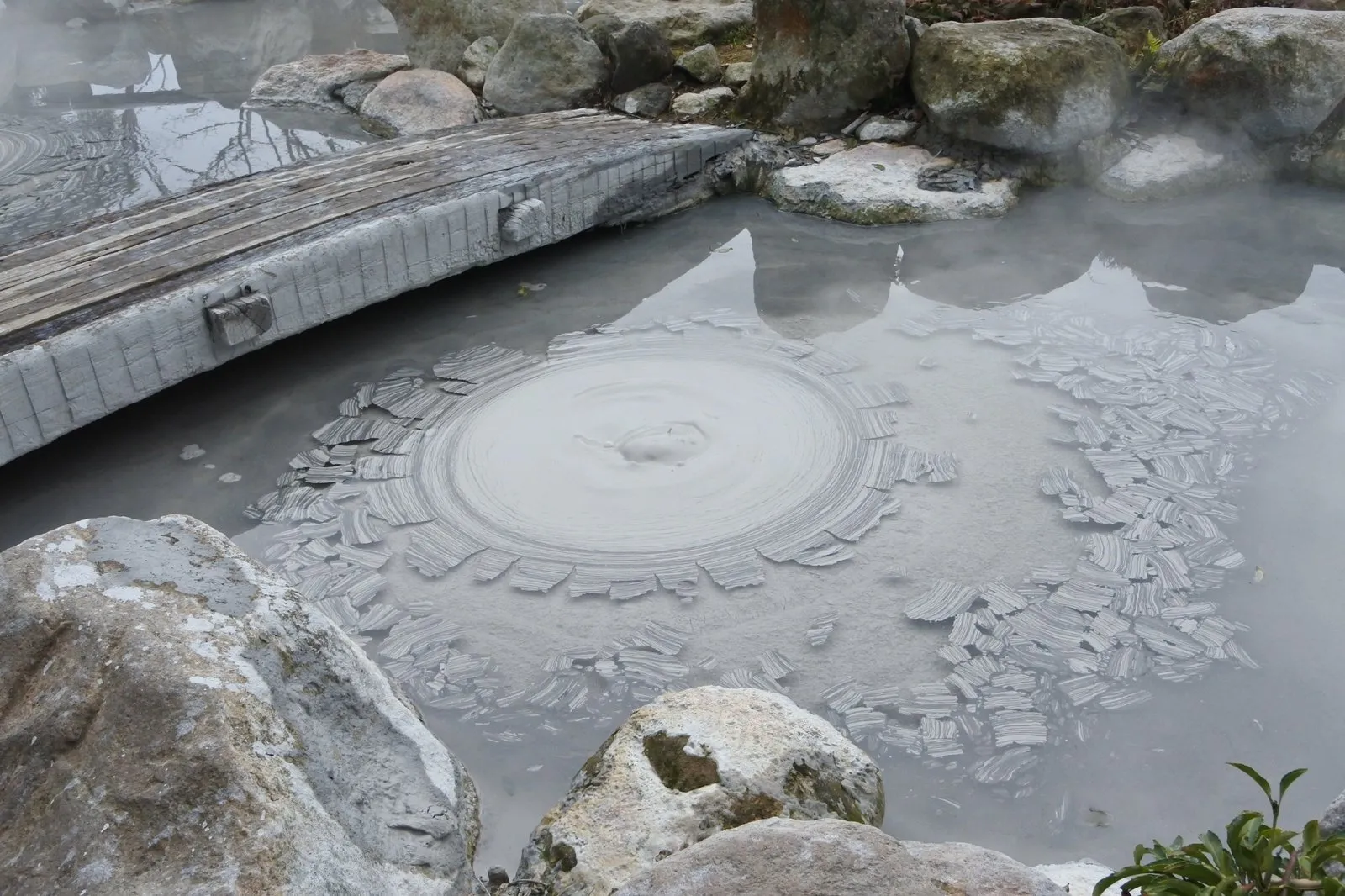
The sound is the real draw.
Goofy and slightly sinister at the same time, and I could have stood there listening to it for a long while.
Where there's a lot of clay relative to the amount of water coming up, the water is thought to mix with it and become thick, hot mud.
Because clay is sticky, steam rising from below can't escape immediately. Gas swells inside the mud until it can't hold any longer, and bursts — that, it is said, is where the *blop, glop* comes from.
Water from the same underground system beneath Beppu ends up as either a clear pond or gray mud, depending on whether the rock it traveled through has been altered.
| Address | Kannawa, Beppu City, Oita (very close to Umi Jigoku) |
| Parking | On-site parking available |
| Highlight | Gray hot mud swelling and popping — the sound is half the attraction |
Kamado Jigoku — a whole showroom of colors on one site
This was my favorite of all the Hells.
Kamado Jigoku.
What makes it fun is that a single site holds several hells with completely different colors and characters, laid out and numbered like street addresses — No. 1, No. 2, and so on.
No. 1 is pale brown hot mud.
No. 3 is blue.
And this blue is far more decisive than the one at Umi Jigoku.
Maybe it’s the white rim around the edge, but the color stands out even harder.
No. 5 is enormous.
Bluish milky-white water spreading out and out.
According to the signage, after a long spell of rain it can turn a clear green.
No. 6 goes back to red-brown hot mud.
It looks shallow, but I read that it’s actually two meters deep, and took a step back without meaning to.
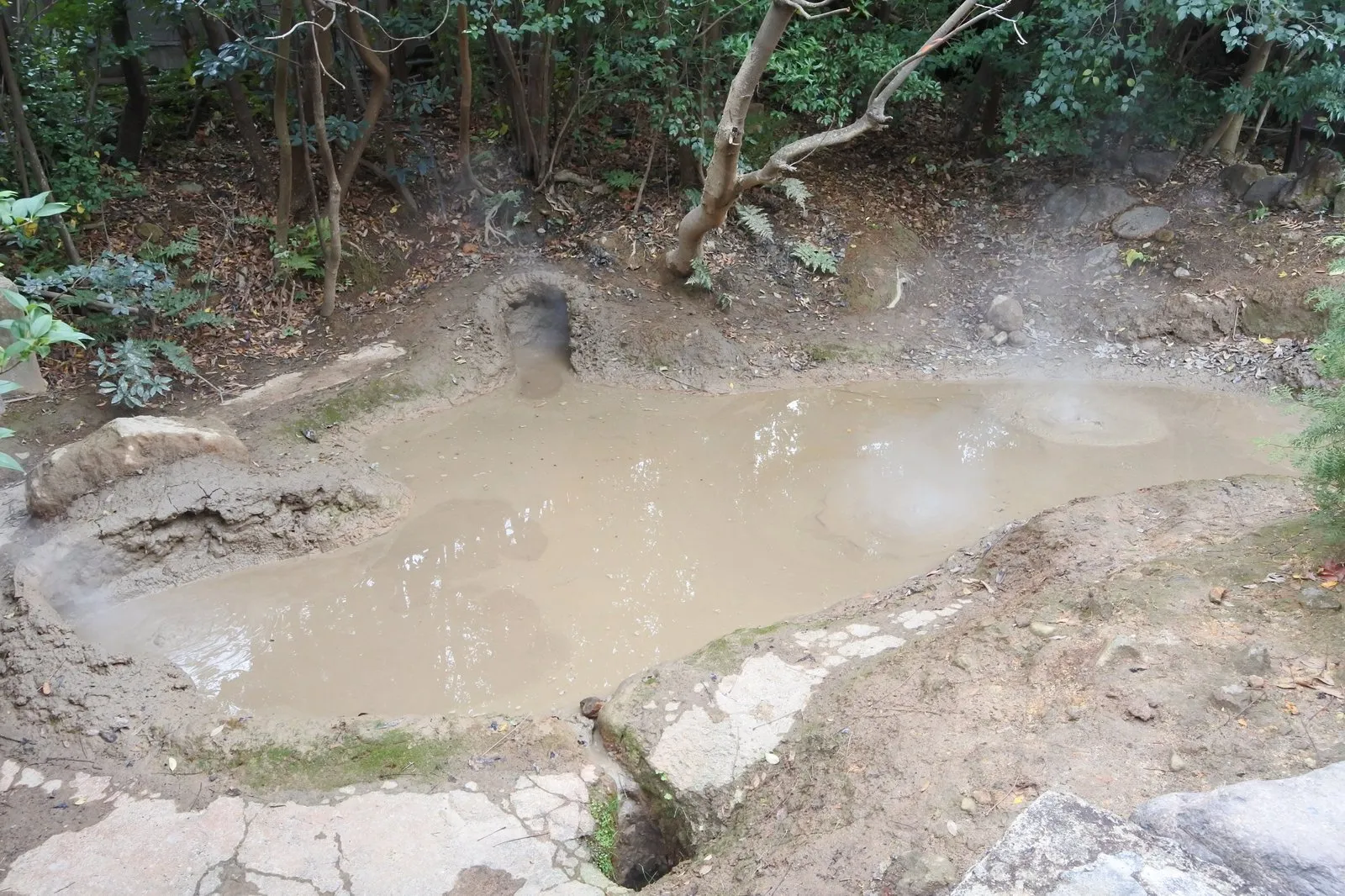
Which of those cracks the water travels through changes the rock it touches, the components it dissolves, and its temperature when it reaches the surface.
Plenty of iron gives red-brown; plenty of clay gives mud; suspended fine particles give bluish milky white. Even vents a short distance apart are thought to end up looking entirely different if they took different routes.
The reason No. 5 is said to change color after long rain is much the same — change how much water soaks into the ground and you change the concentration and the particle load.
The colors of the Hells are a record of the routes taken underground.
| Address | Kannawa, Beppu City, Oita |
| Parking | On-site parking available |
| Highlight | Six numbered hells, each different in color and character — No. 3's blue is a must |
| Watch out for | Some pools are deep even when they look shallow — don't lean over the railings |
Shiraike Jigoku — a green pond, the color of tea
The last stop on the Hells tour was Shiraike Jigoku, “White Pond Hell.”
The name says white, but what was in front of me was a calm pond somewhere between yellow-green and green tea.
The site is large and laid out like a garden.
Without the drama of the red or the blue, it’s a place you can just stand and look at quietly.
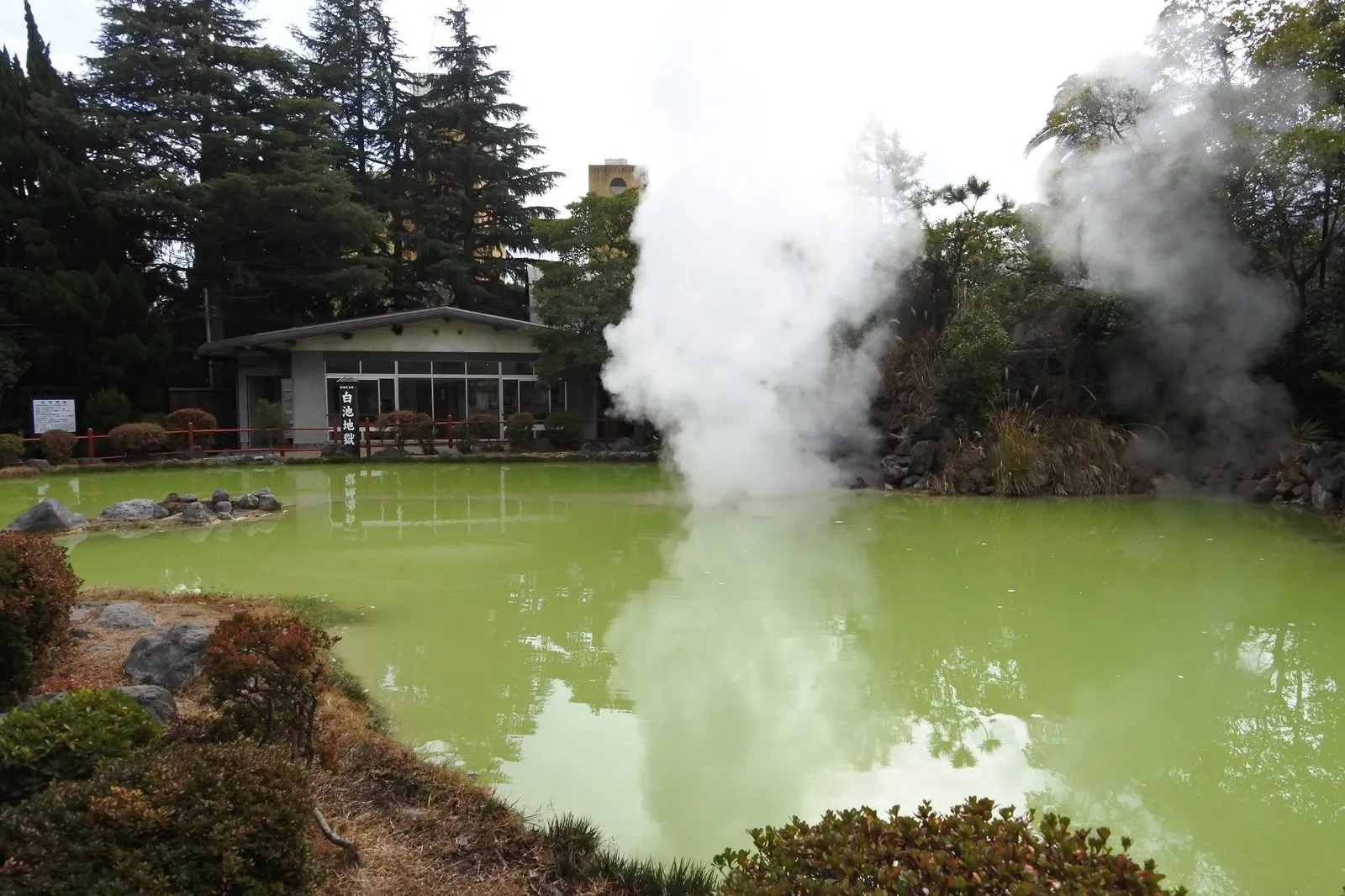
The fun detail here is the tropical fish house.
They use the hot water welling up on site to hold the tank temperature and keep tropical fish.
So that’s another way to use the heat of the ground.
| Address | Kannawa, Beppu City, Oita |
| Parking | On-site parking available |
| Highlight | A yellow-green to tea-colored pond on spacious, garden-like grounds |
| Note | Has a tropical fish house heated by the hot spring water |
Okamotoya Baiten — salt eggs and steam-cooked pudding
Over in Beppu’s Myoban district, I stopped at a shop called Okamotoya Baiten.
What I had there was a salt egg, finished in hot spring steam.
The shell slipped straight off, and the white was beautifully moist.
A different kind of good from the boiled eggs at Umi Jigoku, and I reached for a second one without thinking.
The other thing was jigoku-mushi pudding — custard steamed over the hot springs.
To be fair, I’d had a similar steamed pudding at Umi Jigoku too, but I preferred Okamotoya’s.
Steaming something with heat from the ground shouldn’t make it taste special. And yet somehow it always seems to taste better than it has any right to.
| Address | Myoban, Beppu City, Oita |
| Specialties | Hot spring salt eggs, jigoku-mushi (steam-cooked) pudding |
| Note | An easy stop along the way while touring the Hells |
Yufugawa Gorge — a rock canyon too big for a wide-angle lens
From Beppu I headed inland, to Yufugawa Gorge.
From the parking area, you go down a long flight of stairs. And then more stairs.
On the way down I was mostly thinking, “are we there yet?”
Then I reached the bottom of the gorge, and stopped being able to say anything at all.
“Overwhelming” is the only word that came to mind.
Walls close in from both sides like single enormous slabs of rock, and thin threads of water trickle down all over their surfaces.
I put on a wide-angle lens and still couldn’t fit it in the frame.
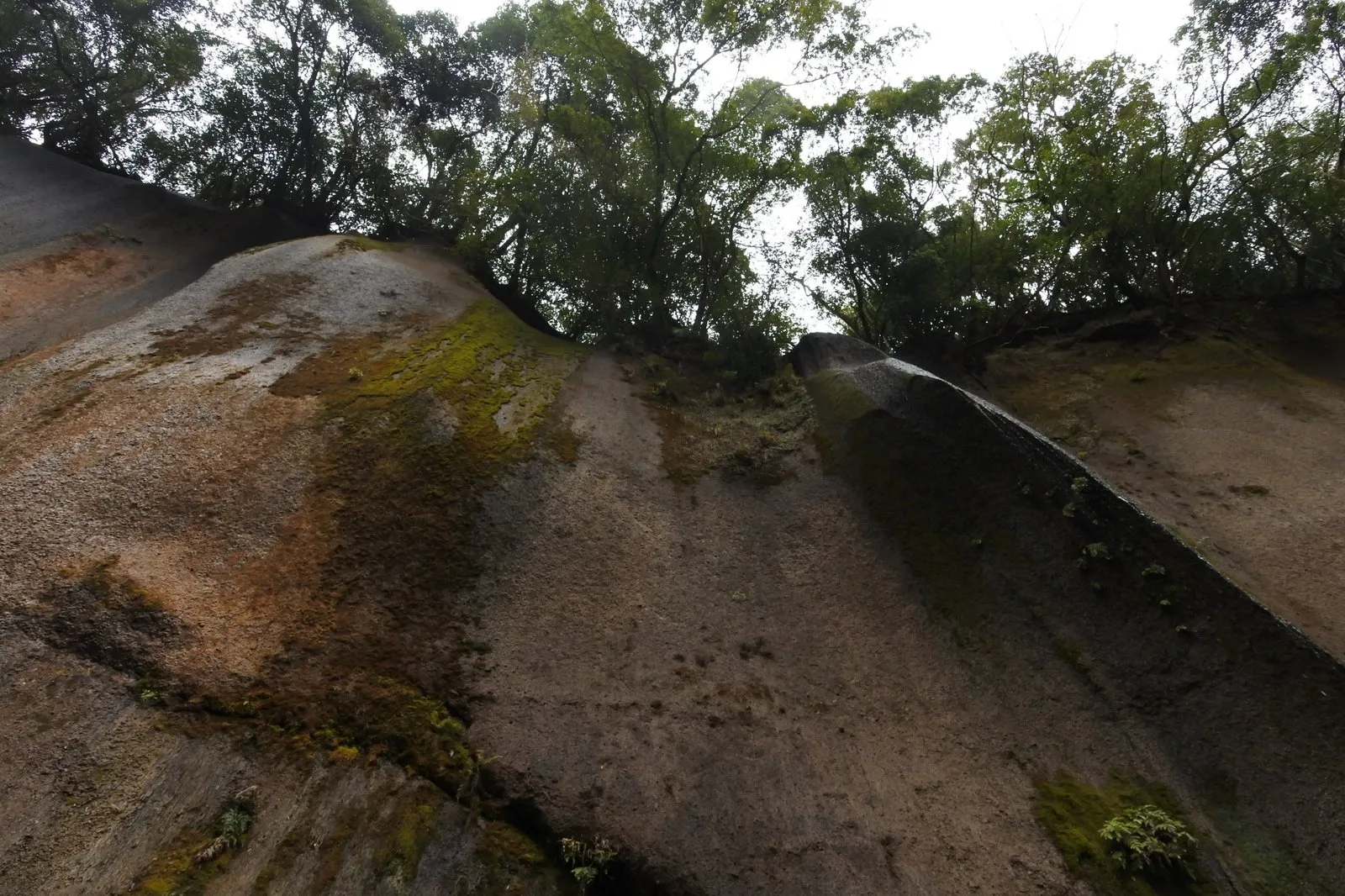
The water at my feet was startlingly clear — clear enough that you feel you should see the bottom, though it also looks deeper than you’d think.
That gap between the transparency of the water and the scale of the rock walls made it a genuinely strange place to stand.
Because pyroclastic deposits are laid down across a wide area all at once, they are thought to form uniform layers of rock without prominent breaks running through them.
When a river then cuts down into that rock like a blade over a very long time, you get walls that rise on both sides looking like seamless single slabs.
The water trickling from all over those walls is said to be groundwater that has slowly percolated through the rock and is seeping out of the face.
The water that carries heat up into Beppu and the water dripping down this gorge are, at root, the same thing — water moving through rock. That thought left me feeling slightly odd.
| Address | On the border of Yufu City and Beppu City, Oita |
| Parking | Parking at the entrance |
| Access | A long stairway down to the gorge floor — and back up again on the way out |
| Watch out for | Wet rock is slippery. Stay away when the water is high |
Higashi-Shiiya Falls — the walk was unnerving, but I’m glad I went
The next day I gave over to waterfalls.
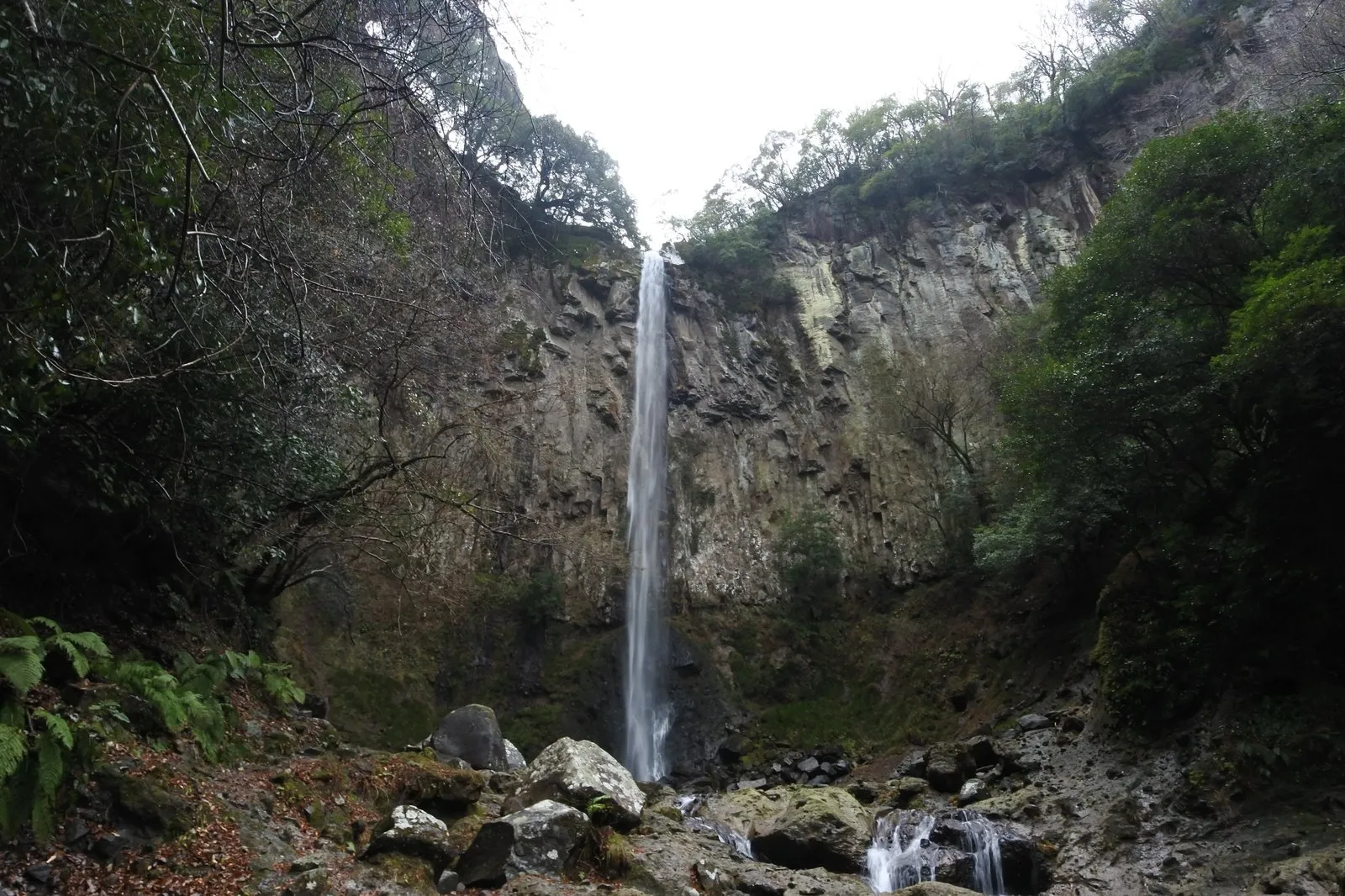
First up was Higashi-Shiiya Falls.
The short version: it was hard work.
But what was waiting at the end was more than worth it.
The path to the falls has a few genuinely unnerving stretches, if I’m honest.
It was a winter morning with hardly anyone around, and I stopped more than once wondering whether I was even on the right trail.
Keep going, though, and the falls appear.
The moment I saw them, I was simply glad I’d come.
A single fall of water drops at the far end of a space ringed all the way around by sheer rock walls.
That sense of being enclosed is the thing.
The sound bounces off the walls, and it starts to feel like your whole body has stepped inside the waterfall.
| Address | Usa City, Oita |
| Parking | Parking at the entrance |
| Access | A walking path from the parking area, with some rough footing |
| Watch out for | Wear proper shoes. Watch for ice on the path in winter |
Ryumon Falls — easy to reach, and still spectacular
Later the same day I stopped at Ryumon Falls.
This one was the exact opposite of Higashi-Shiiya.
Easy to reach by car, and barely any walk from the parking area to the falls.
And the view when you get there is still spectacular.
Getting that much impact without the effort was, frankly, welcome.
It’s easy to assume waterfalls are better the harder they are to reach. Turns out that isn’t necessarily true.
| Address | Kokonoe-machi, Kusu District, Oita |
| Parking | Parking near the falls |
| Access | Easy to reach by car or on foot |
| Highlight | A powerful flow you can see from close up |
I also stopped at Fukino Falls the same day.
The road there is narrow, though, with no room to pass oncoming cars, and the walking course couldn’t really be described as well maintained.
What stayed with me was less the waterfall itself than the journey to get to it.
If you’re going, take real care with both the driving and your footing.
Ryu-no-Hige — Mt. Yufu and a sea of clouds, from the bedroom window
That night I stayed at a ryokan in Yufuin called Ryu-no-Hige.
And the next morning, I opened the curtains and made an involuntary noise.
Perfectly clear skies.
Straight ahead through the window, Mt. Yufu, solid and broad.
And below it, lying across the low ground in front, a white sea of clouds.
Mountain, cloud, and morning light, arranged into a single picture.
Getting a view like that without leaving the room was the single luckiest thing that happened on this trip.
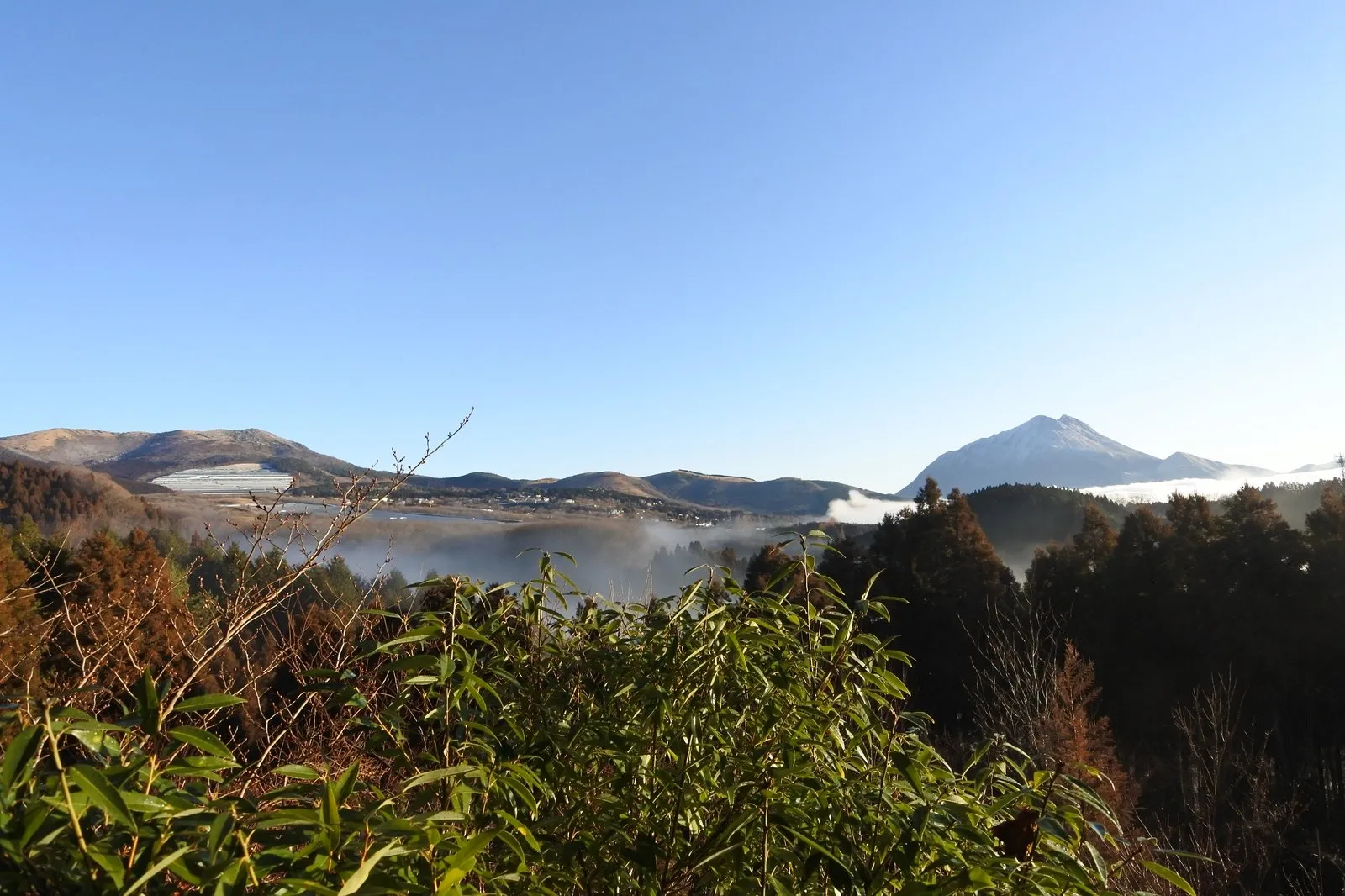
On clear, windless nights, heat escapes from the ground into the sky, and the chilled air grows heavy and pools at the bottom of the basin.
Add the water vapor rising from the rivers and hot springs, and the air is said to cool into fog that fills the basin with white.
Seen from above it looks like a sea of clouds; from inside the basin it's simply deep morning fog.
It is thought to be most likely on clear, sharply cold mornings from autumn through winter. The clear sky and the chill that morning were exactly those conditions lining up.
| Address | Yufuin-cho, Yufu City, Oita |
| Highlight | Mt. Yufu from your room — and, with luck, the morning sea of clouds |
| Note | The view depends on the weather. Clear, cold mornings are your best chance |
Lake Kinrin — steam rising off the water
The signature sight of Yufuin is Lake Kinrin.
My honest first reaction on arriving was, “smaller than I expected.”
You can walk the whole way around it without much time passing.
But as I stood there looking, the scene started to change.
White steam began drifting up off the surface of the lake.
The water hazed over, and the trees on the far bank blurred into softness.
The lake I’d thought was small suddenly seemed to have depth.
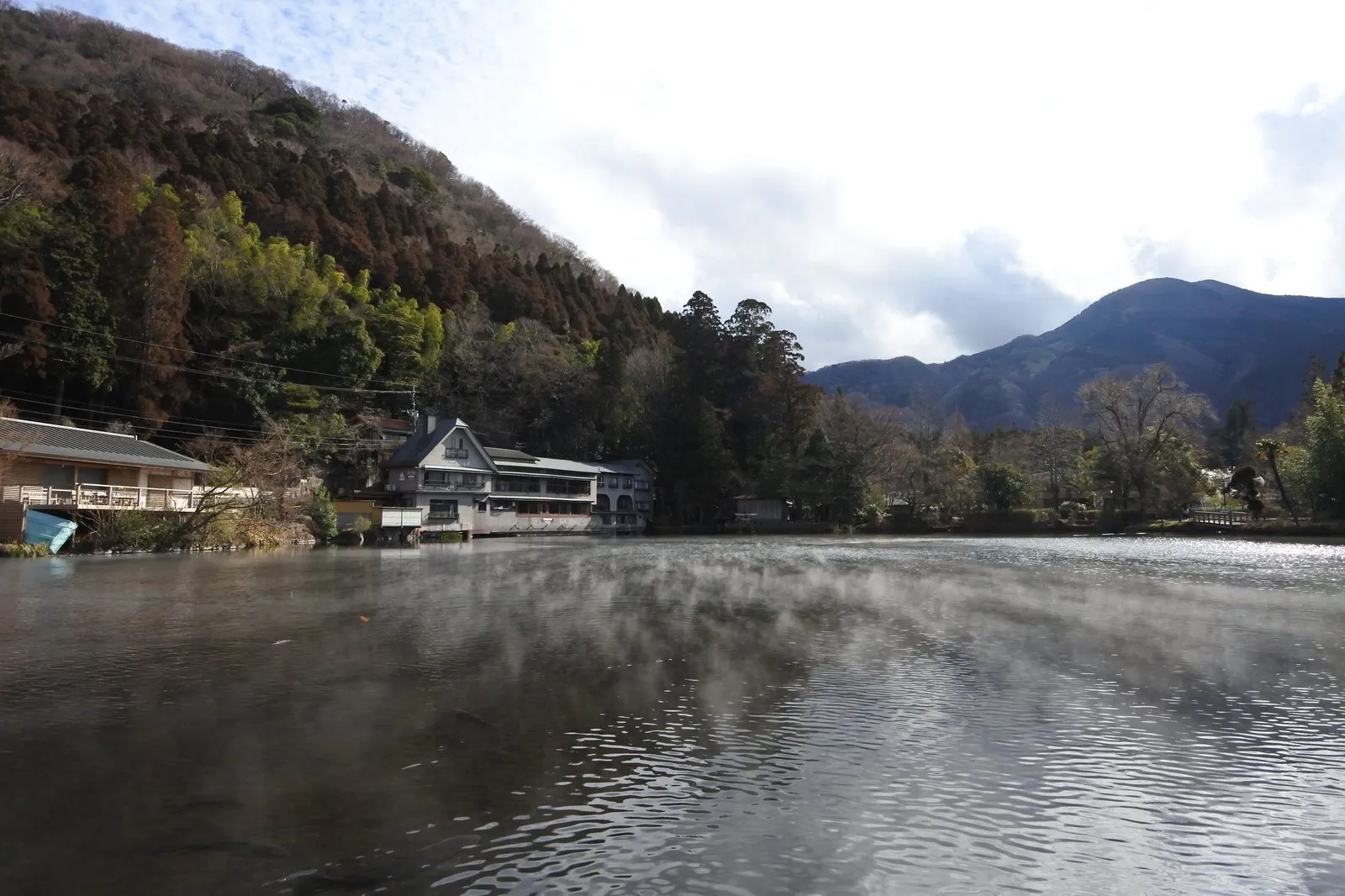
As a result, the lake stays far warmer than the outside air, even in winter.
The air just above that warm surface is humid, and when cold outside air touches it, the vapor cools into tiny droplets. That, it is said, is what you see as steam.
So the colder it gets, the thicker the steam. That is thought to be why the lake is said to look its best on cold winter mornings.
Here too, heat arriving from underground is what makes the view.
| Address | Kawakami, Yufuin-cho, Yufu City, Oita |
| Parking | Paid parking in the surrounding area |
| Highlight | Steam rising off the water — thicker the colder the morning |
| Note | A lap takes only a short while. Walkable from Yunotsubo Kaido |
Yunotsubo Kaido, and what I ate in Yufuin and Beppu
Yunotsubo Kaido, the street running back from Lake Kinrin, was packed.
Just walking it took effort, and it wasn’t really the setting for browsing at leisure.
If I come again, I might treat the street purely as a shopping errand.
The freshly baked Käsekuchen and the brown-sugar karinto manju were worth queuing for, though.
The food in Oita more broadly was excellent.
Start with toriten, the local battered fried chicken.
I had the honke toriten set at Toyoken (¥1,430).
The batter is airy and light, and for fried food it sits remarkably lightly.
I kept going back for another piece purely because it never felt heavy.
Then there was yaseuma at Kanmi Chaya (¥400).
This one was a genuine revelation.
Generously coated in kinako soybean flour, with noodle-like strips of dough that have real chew to them.
Rustic, and completely unforgettable.
I also had charcoal-grilled Bungo beef, as part of the Keishuan gozen set (¥3,500) — grilled over coals right in front of you as you eat.
| Address | Kawakami, Yufuin-cho, Yufu City, Oita |
| Access | The street running from Yufuin Station toward Lake Kinrin |
| Shopping | Freshly baked Käsekuchen, brown-sugar karinto manju, and more |
| Watch out for | Very crowded during the day. Mornings are easier going |
The steam and the sea of clouds turned out to share a root
A red pond, gray mud, turquoise water.
Rock walls at the bottom of a long stairway, and a waterfall ringed in stone.
A morning sea of clouds, and steam off a lake.
Piece by piece, they had all looked like unrelated scenery.
But once the trip was over, it was clear that every one of them had been made by the same thing — heat and water arriving from underground.
Beppu is said to have hot water because a pathway (the faults), a heat source (the volcanoes), and soaked-in rainwater all happen to coincide.
The Hells are thought to differ in color because the water took different routes to get there.
The fog in Yufuin’s mornings and the steam off Lake Kinrin trace back to the same heat.
Oita felt like a place where the ground underneath never stops working.
And that heat is what boils the eggs, steams the pudding, and fills the bath at the ryokan.
The frankly alarming power of the ground and the deliciousness of a hundred-yen boiled egg, sitting in the same place.
That mismatch was the most enjoyable thing about the whole trip.
Next time, I’ll skip the crowded street and start the day walking at Lake Kinrin first thing in the morning.
Geological references: Geological Survey of Japan, AIST ("Geology Map Navi"); Geospatial Information Authority of Japan topographic maps; Headquarters for Earthquake Research Promotion, published material on the Beppu–Haneyama Fault Zone. Statements written as "is said to" or "is thought to" reflect prevailing interpretation rather than settled fact.