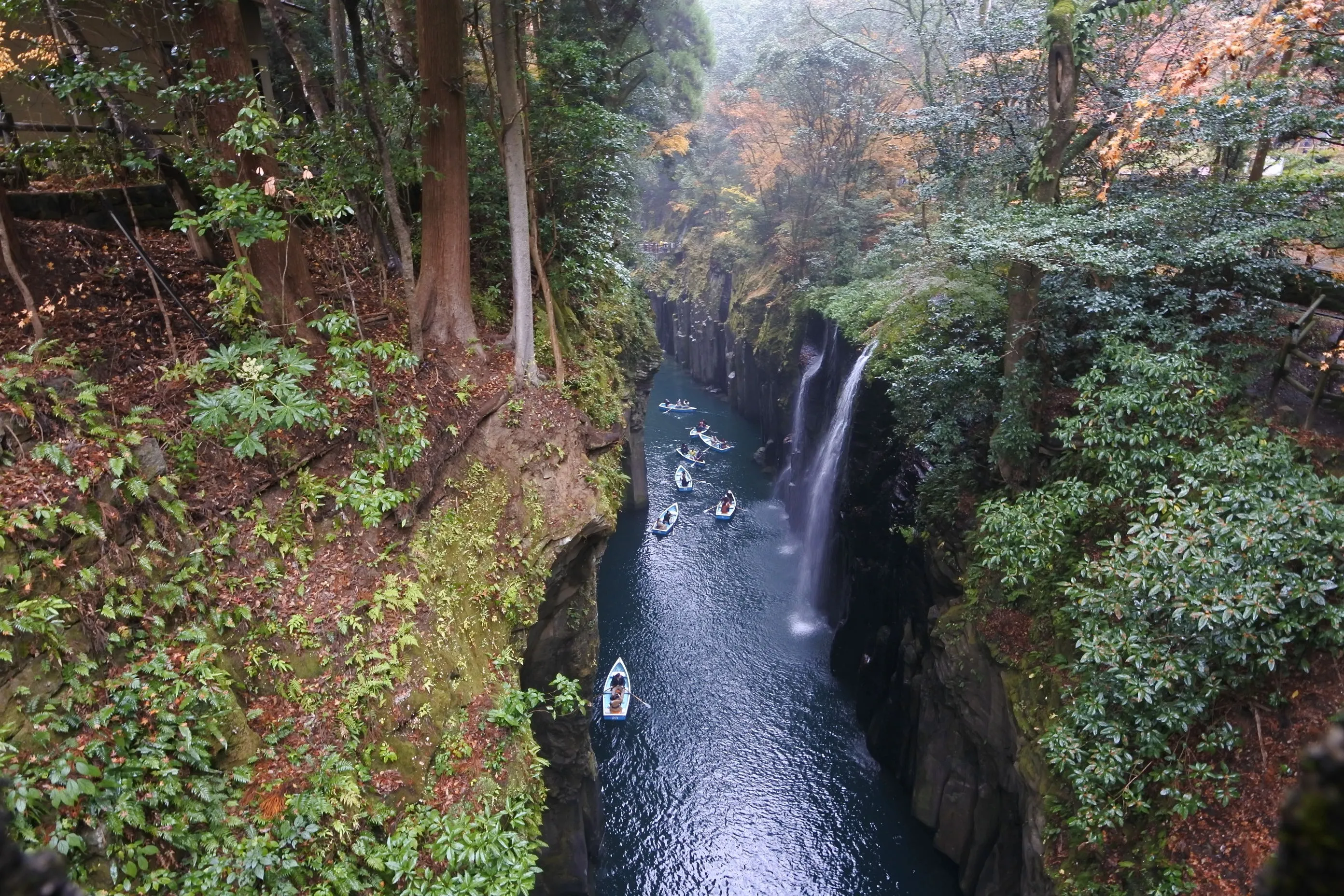
When I looked up from the boat, I couldn’t speak.
Walls — left and right.
Sheer gray rock rising almost straight up, and from somewhere near the top, a thin white thread of water dropping down toward us.
“How does a place even become this shape?”
I kept asking myself that the whole time I was rowing.
📅 Visited: November 2023
Takachiho Gorge — looking up at Manai Falls from a rowboat
The rental boats at Takachiho Gorge need to be booked in advance.
We reserved two: my wife and I in one, my parents in the other.
We headed to the dock around 9:30 a.m., and that’s when we hit the first surprise — the stairway down to the riverbank is long.
My grandma (75) used up more energy than she expected just getting down to the water. Later she told us, “I had no idea it would be that tough.”
If you’re bringing an older family member, that’s worth knowing ahead of time.
Once we were in the boat and had paddled for a few minutes, Manai Falls appeared right in front of us.
It didn’t fall the way I expected. It wasn’t water pouring from above — it was more like water seeping out from deep inside the cliff. A strange, gentle kind of flow.
The view was as good as everyone says. I was so glad we’d come.
This is called columnar jointing.
Around 270,000 and 90,000 years ago, the nearby Mt. Aso volcano produced enormous eruptions. Superheated pyroclastic flows poured into this area, and as that lava cooled and hardened it contracted evenly — cracking into hexagonal columns as it shrank.
Then the Gokase River got to work, slowly carving its way down through that hard rock over tens of thousands of years. The narrow V-shaped gorge you see today is the result.
So what about Manai Falls? It isn't fed by a river flowing in from above. It's spring water, seeping out from between the layers of basalt where the old lava flows meet. That's why it looks like it's emerging from inside the cliff — because, in a way, it is.
There’s also a walking path along the river, well maintained the whole way. We strolled it after returning the boats.
Walking the gorge from above and beside the water gives a completely different feeling from being down on the water — the cliffs press in just as close, but you get to take them in slowly, on your own legs.
| Address | Mitai, Takachiho-cho, Nishiusuki District, Miyazaki |
| Booking | Reservation required (book early in peak season) |
| Watch out for | A lot of stairs down to the boat dock — pace yourself if you're older |
| Parking | Paid lots nearby |
Iwato Jinja and Amano Yasukawara — walking through myth
Before the gorge, on the previous day, we visited Iwato Jinja (天岩戸神社) — and I want to write about that here too.
This is the shrine that marks the legend of Amaterasu, the sun goddess, hiding herself inside a cave. “Ama-no-Iwato” — when the sun vanished and the world fell into darkness. The myth is rooted right here, in this exact spot.
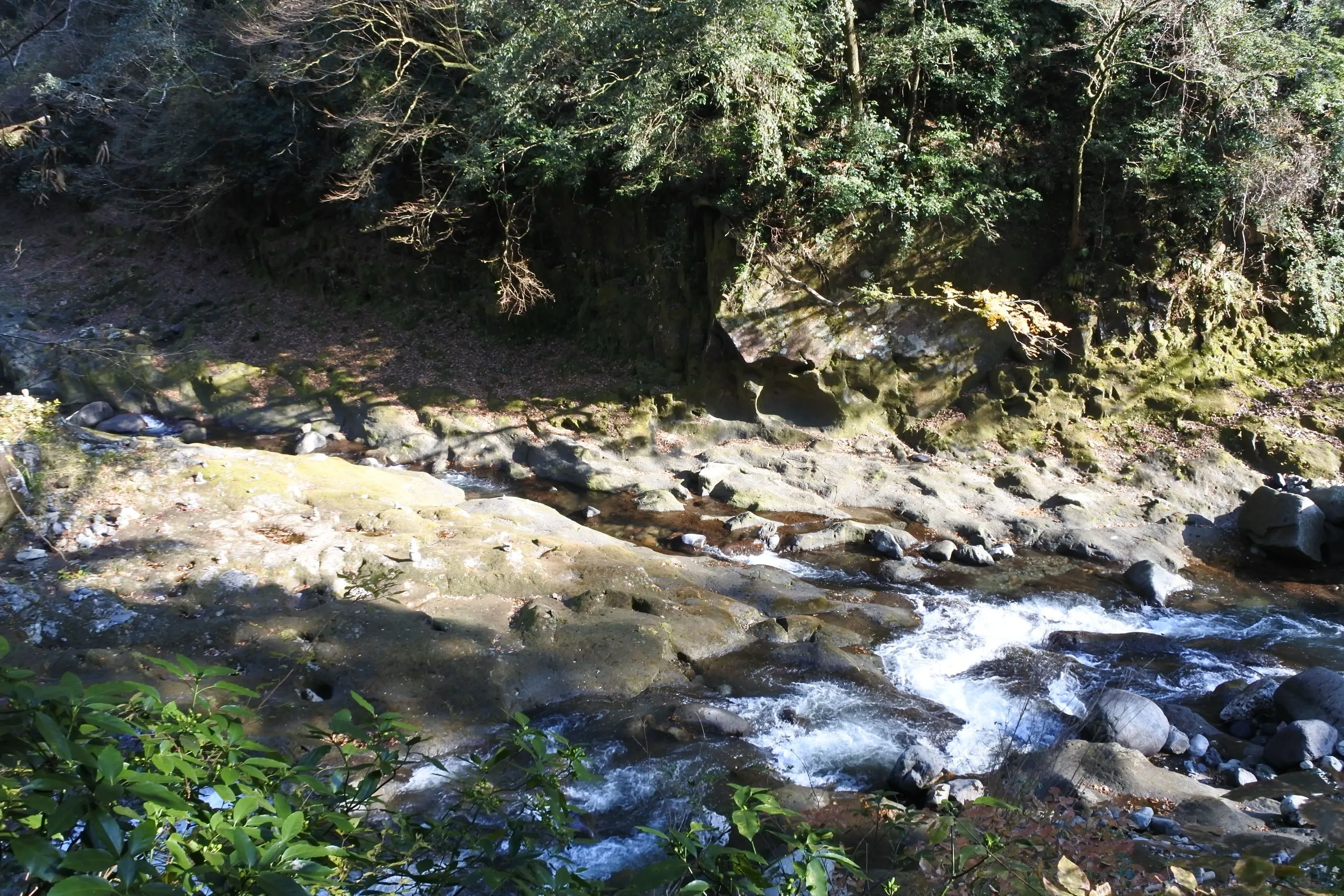
The Iwato River runs straight through the shrine grounds, the water so clear it almost feels like the word “sacred” was invented for it.
Get close to the cliff face and you can see water glistening as it seeps out of the rock itself.
 Click to enlarge
“So this is where Amaterasu hid.” Once that thought lands, the rocks stop feeling like just big rocks.
A short walk from Iwato Jinja brings you to Amano Yasukawara (天安河原).
You follow a forested path along the river, and at the end of it a massive cave opens up in front of you.
In front of the cave, and across the rocks around it, are countless small stone cairns — stacks of pebbles left by visitors over the years. The atmosphere is strange, almost unsettling, but quiet at the same time.
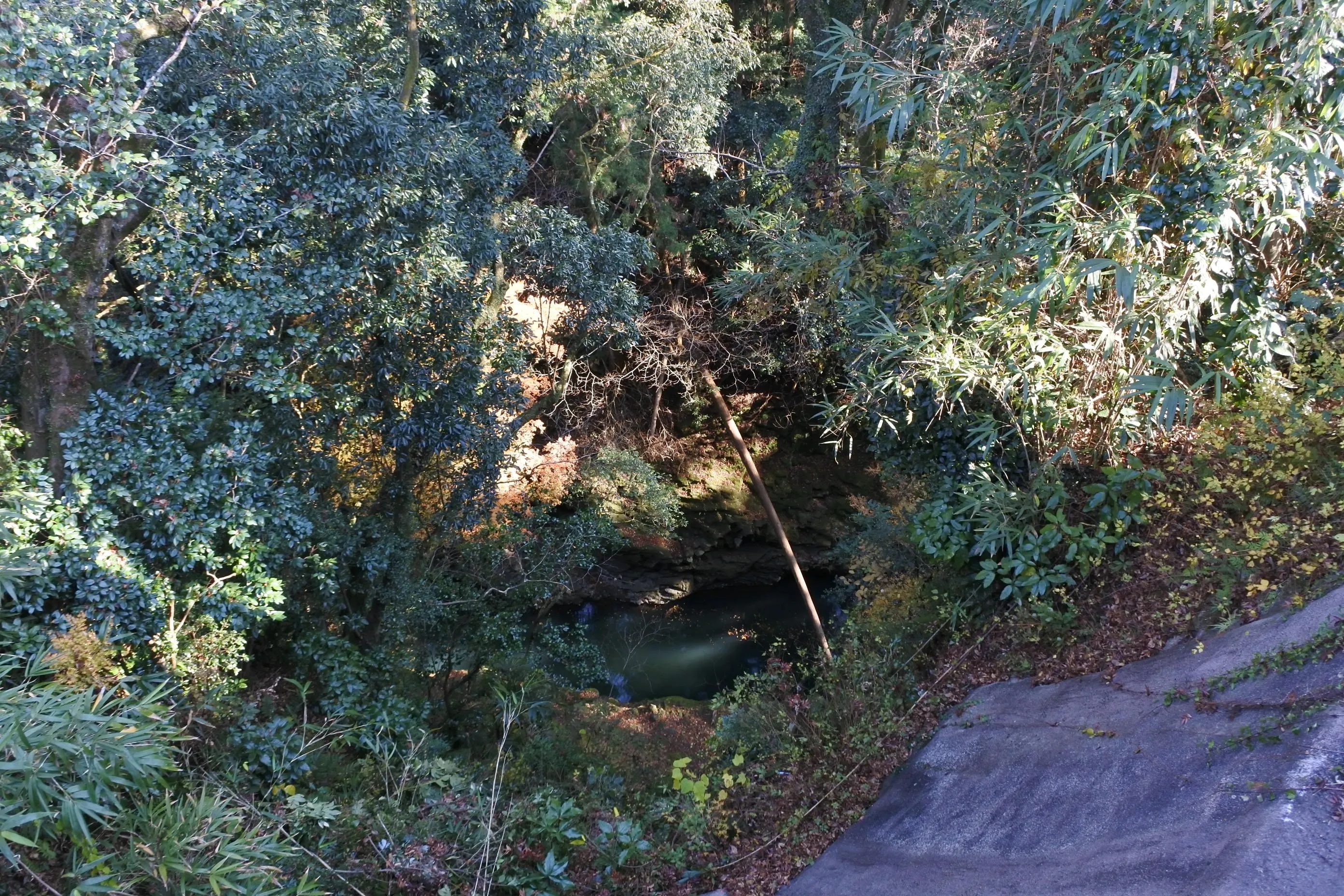
Most of the route is on ramps, but there are some stairs in places.
We hit it during peak autumn-foliage season, and the crowds were bigger than I’d expected.
| Address | Iwato, Takachiho-cho, Nishiusuki District, Miyazaki |
| Parking | Parking lot near the shrine |
| Watch out for | Some stairs along the path; expect crowds in season |
Kunimigaoka Observatory — one line from my father
After Amano Yasukawara, we drove up to a viewpoint that looks out over the Takachiho mountain range.
Kunimigaoka (国見ヶ丘) — literally, “the hill where you look out over the land.”
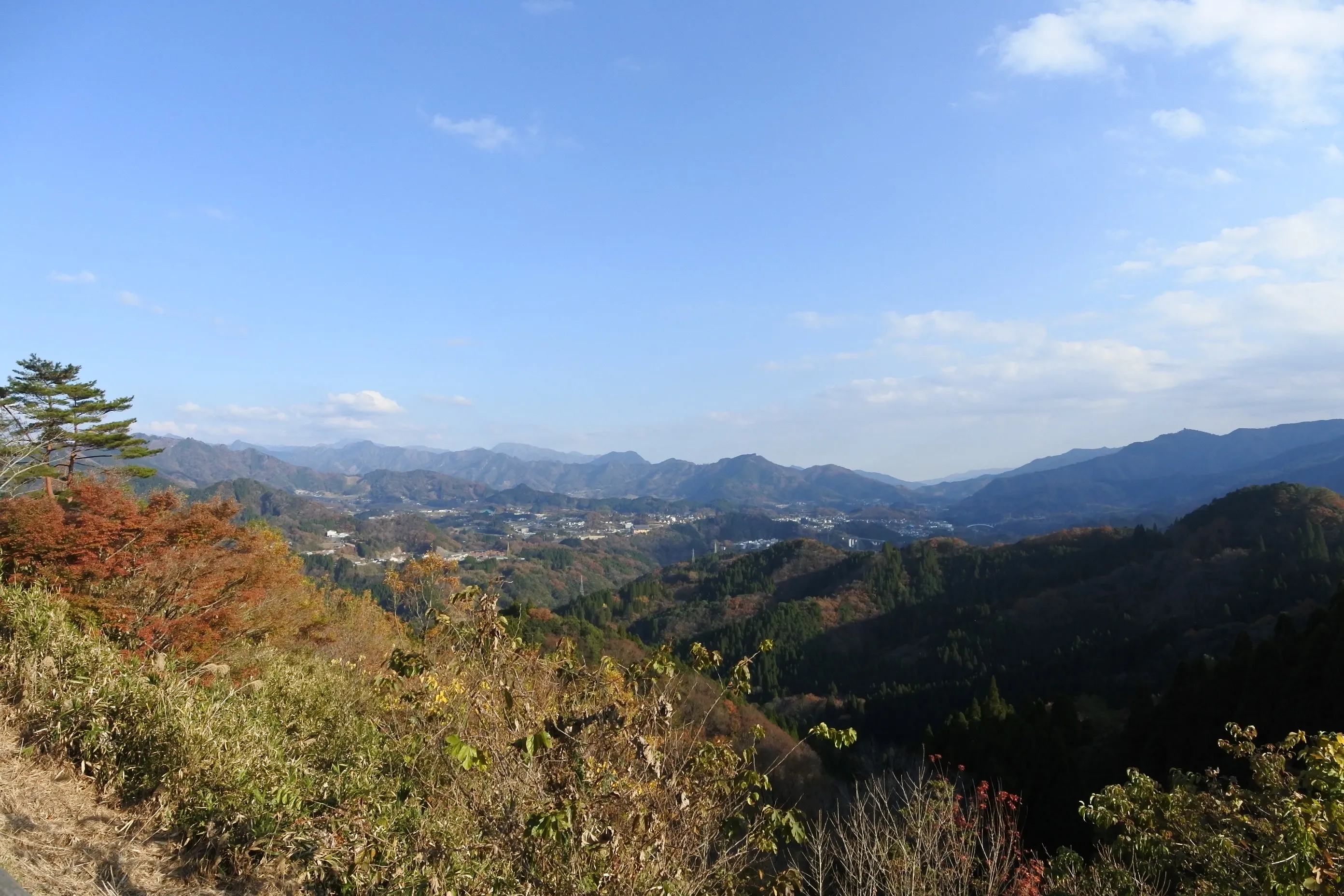
From the wide observation deck, ridge after ridge of mountains rolls off into the distance, fading further the longer you look.
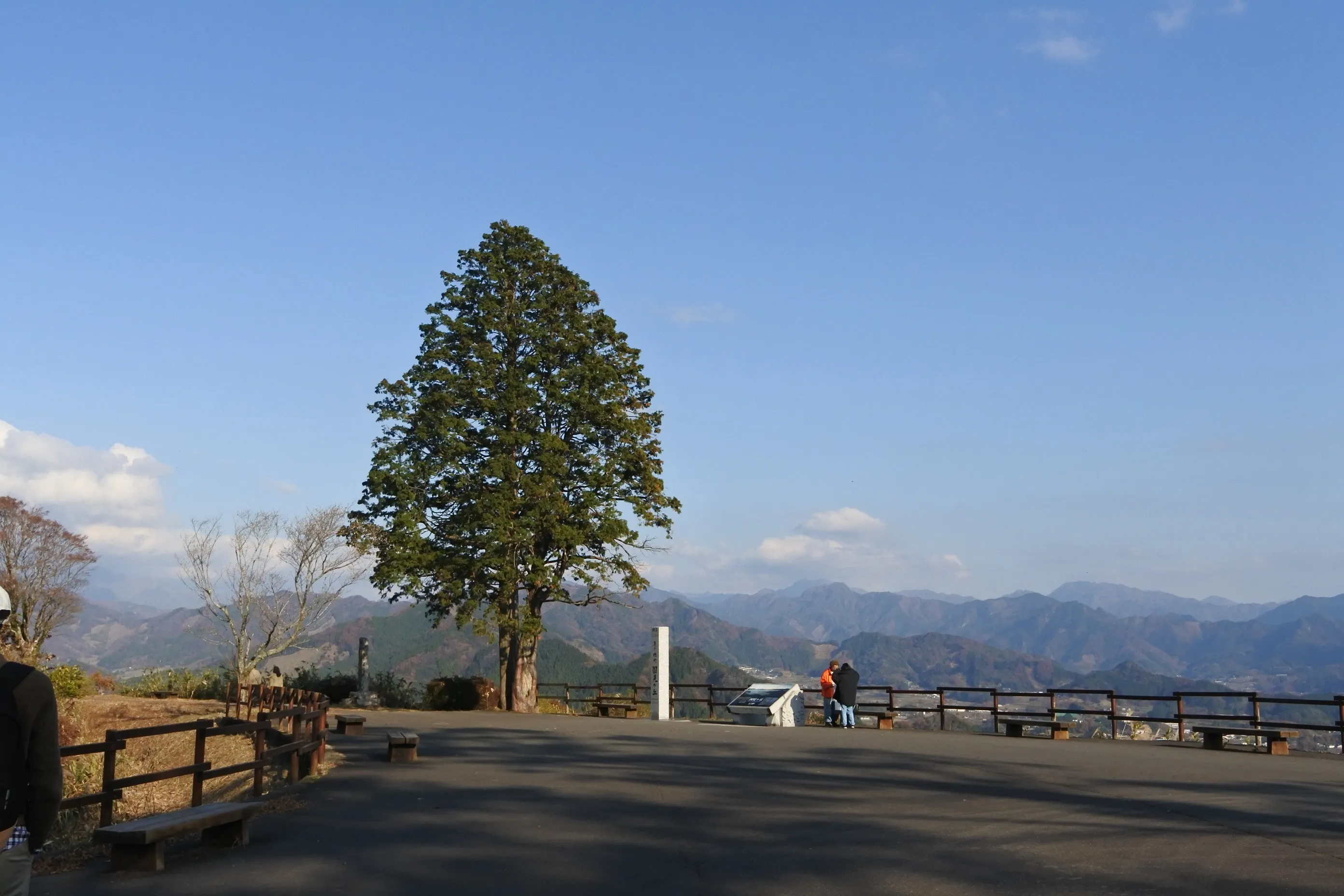
My father stood there for a while, thought about it, and then said:

To be fair, the name does set you up for a full 360-degree showpiece view.
But personally, I thought it was plenty.
The clouds were hanging low, and the mountain ridges faded into a kind of haze — and that, more than a crisp panorama, felt like the real Takachiho to me.
| Address | Oshikata, Takachiho-cho, Nishiusuki District, Miyazaki |
| Parking | Free parking next to the observatory |
| Note | Famous for its sea of clouds — best at dawn (Nov–Feb) |
Hanare-no-Yado Kamigakure — dinner across three generations
Our home base for this trip was Hanare-no-Yado Kamigakure (離れの宿 神隠れ), a ryokan tucked into the mountains of Takachiho.
We split into two rooms: my parents and grandma in “Kogane” (Japanese-style with a kotatsu), and my wife and I in “Akanegumo” (Western-style with a private bath).
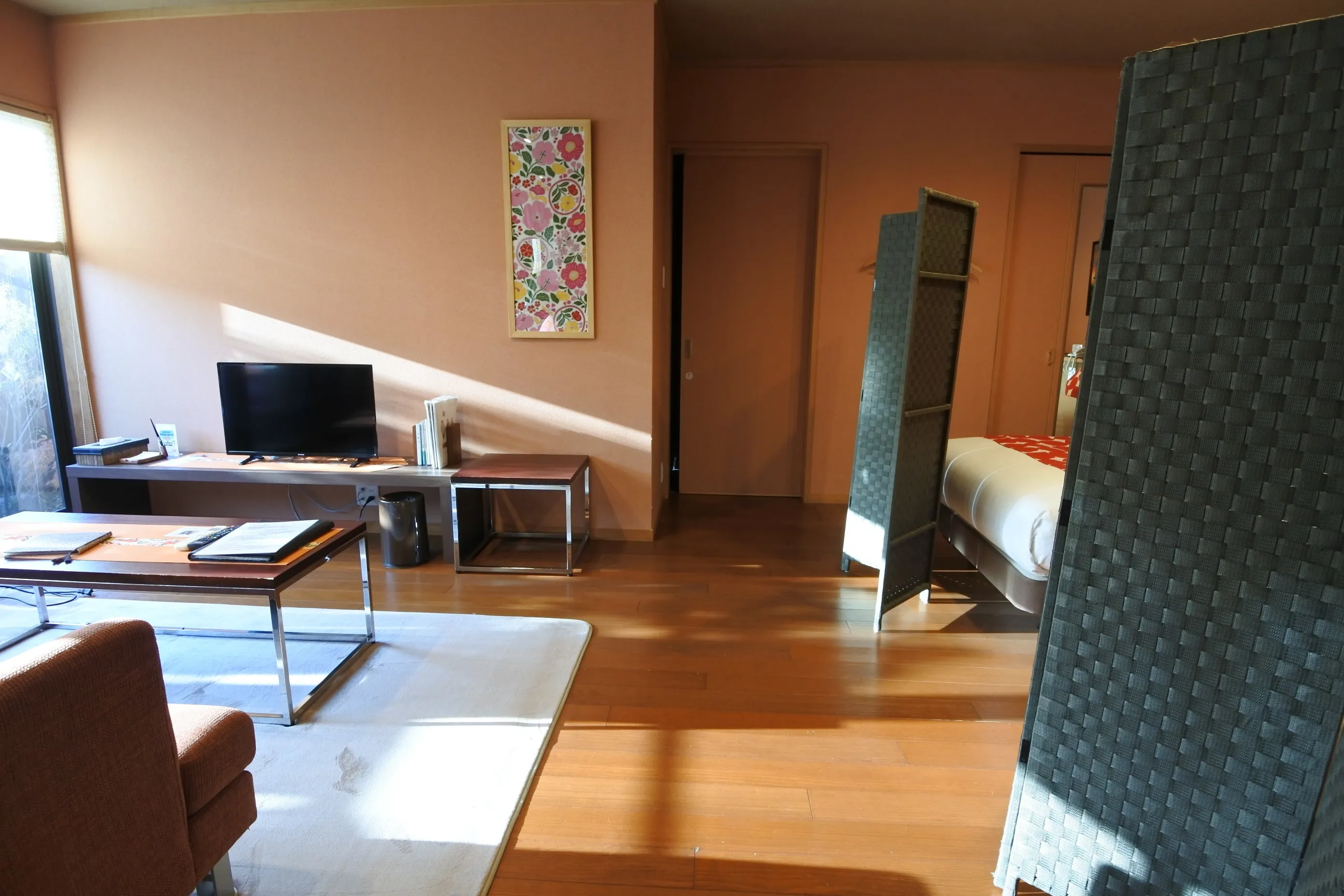
Step inside the room and the first thing you notice is the quiet.
Being a mountain ryokan, almost no sound from the outside reaches the rooms. Through the window, only dark trees.
The thing that stuck with me most about this inn, though, was dinner.
The moment the salt-grilled ayu (sweetfish) hit the table, my mother let out a sound:

Bamboo-grilled gratin, lotus-root manjū — everything used local ingredients, and nobody at the table stopped eating until the courses ran out.
The next morning’s breakfast was traditional Japanese. My grandma was particularly happy about the rice, eating slowly and saying again and again, “Nothing beats plain white rice.”
The ryokan was a hit with all three generations, but especially with my mother and grandma —

One note from my wife, though:

It’s a detached cottage in the mountains, so depending on the season, that’s probably something to be ready for.
After dinner, the ryokan ran a shuttle over to Takachiho Jinja for the night Kagura.
| Address | Takachiho-cho, Nishiusuki District, Miyazaki |
| Shuttle | Shuttle to Takachiho Jinja for the night Kagura (confirm at booking) |
| Note | Detached cottages in the mountains — be ready for the occasional bug in warmer months |
Takachiho Yokagura — a dance of light and masks
Every night at Takachiho Jinja, four selected acts of Takachiho Yokagura (高千穂夜神楽) are performed for visitors — a window into the longer all-night ritual that the local community keeps alive through the winter.
The show runs from 7:40 p.m. for about ninety minutes, retelling pieces of the same myths we’d been walking through earlier in the day.
The moment the masked dancer stepped onto the dim stage, the whole room went still.
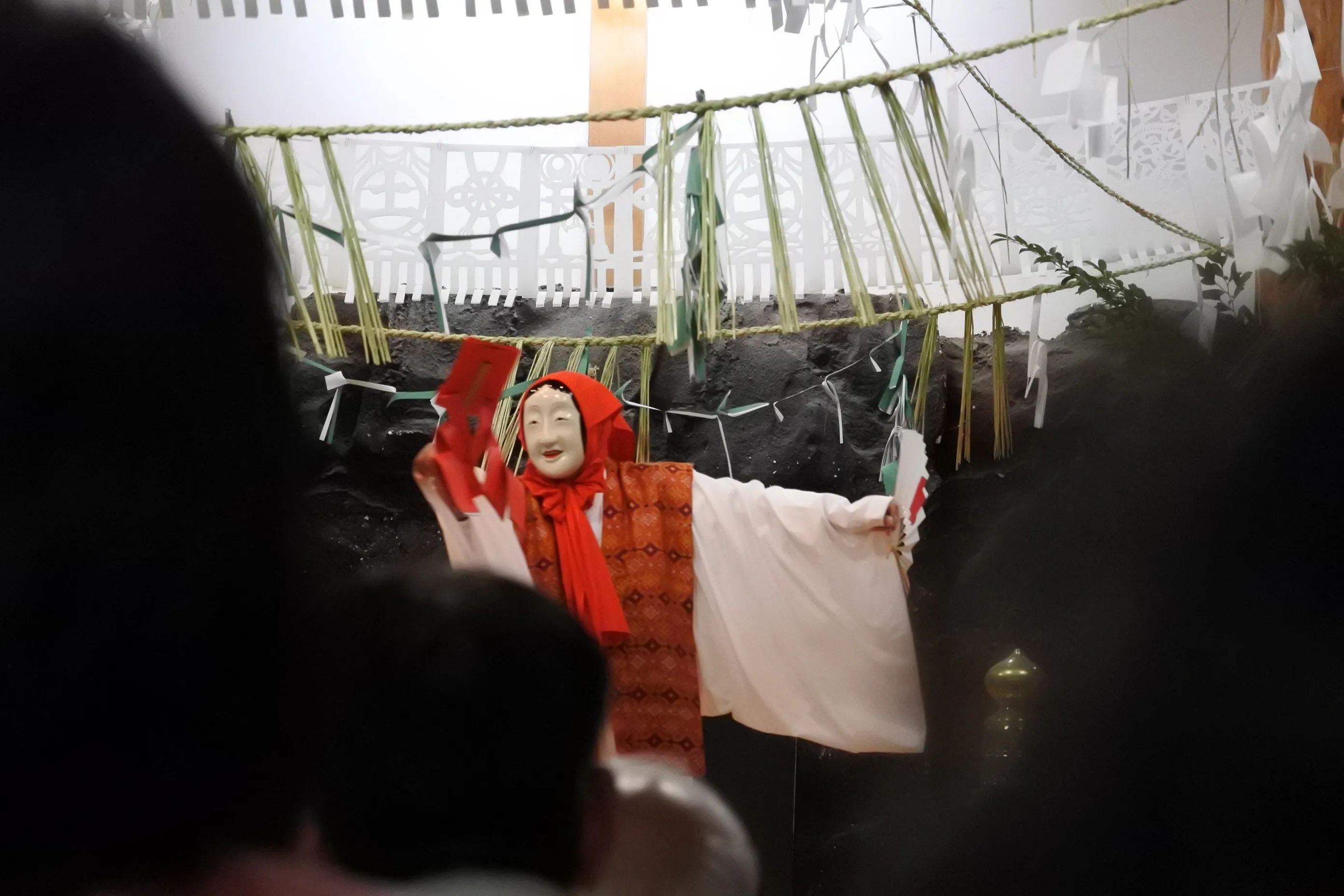
A white-masked god and a red-masked oni — each one moved completely differently. Even though their faces don’t change, they somehow seem to have expressions.
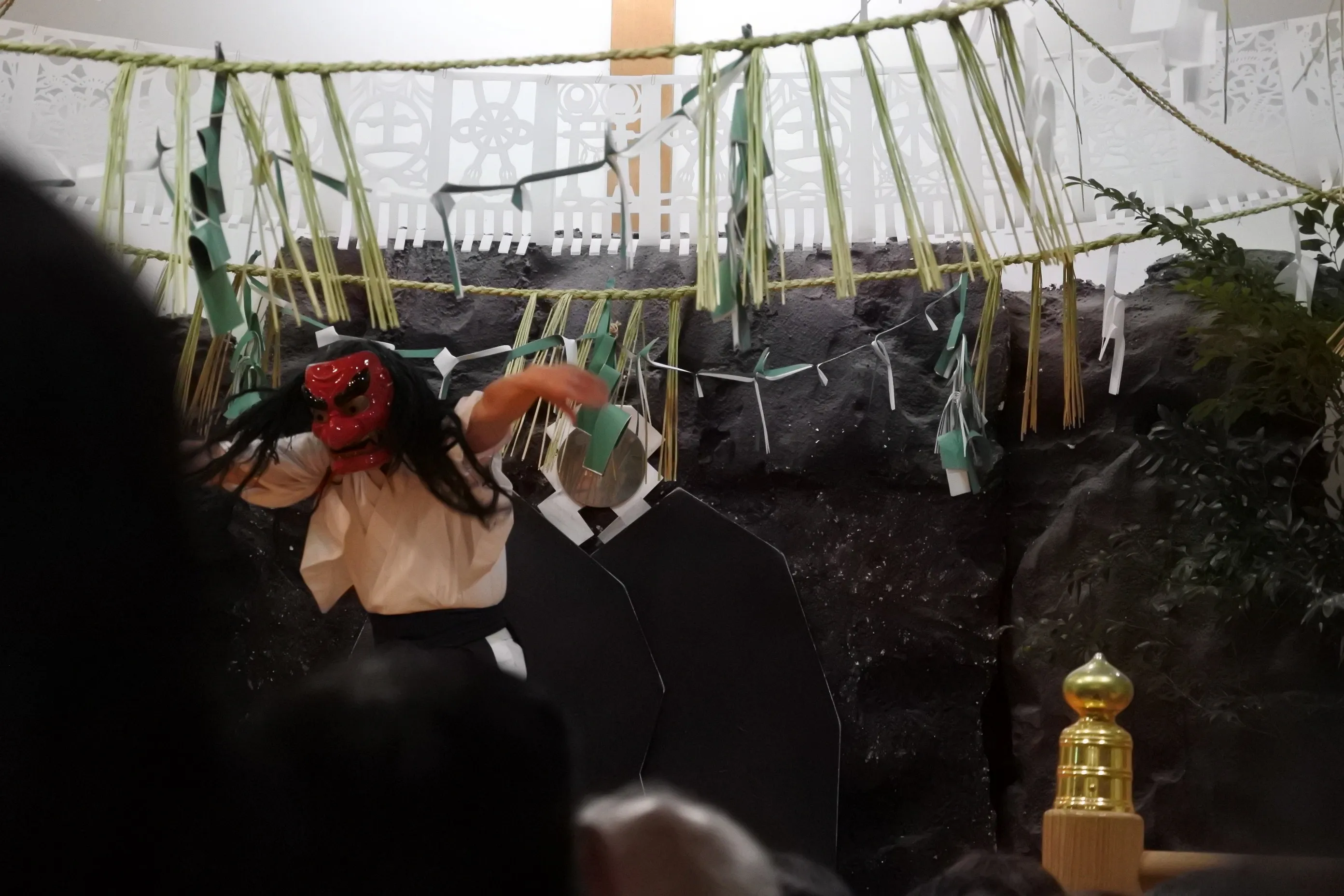
The audience was a mix of Japanese and international visitors, all watching in complete silence.
Reactions in our family ran the gamut.
My parents thought it was “quite something.” My grandma, on the other hand, was starting to nod off by the end — ninety minutes is, fairly, a stretch when you’re 75.
Still, every one of us stayed in our seat to the very end.
And the next morning, all five of us said the same thing about it: “Glad we saw that.”
| Address | 1037 Mitai, Takachiho-cho, Nishiusuki District, Miyazaki |
| Time | Nightly, 19:40–21:10 (about 90 minutes) |
| Fee | ¥800 for adults (as of 2023) |
| Note | A ryokan shuttle (if available) makes the round trip much easier |
Leaving Takachiho
This trip was five of us across three generations — me, my wife, my father, my mother, and my grandma.
Same trip, but everyone took something different from it.
My father, who’d called Kunimigaoka a letdown, was the most cheerful person at the ryokan breakfast table.
My grandma, who’d dozed through parts of the Kagura, was the one who said “I want to come back” — about the ryokan.
Some people loved every minute. Some people got a little worn out. That’s just how a multi-generation trip goes.
But every one of us touched this place.
The air over Takachiho, the sound of water seeping out of stone, the way the light caught the masks at Kagura —
I think each of us came home with the kind of memory you can’t quite put into words. And that’s enough.
Geological references: Geological Survey of Japan, AIST ("Geology Map Navi"); Geospatial Information Authority of Japan topographic maps. Statements written as "is thought to" or similar reflect prevailing interpretation rather than settled fact.